-
Shop
- Advanced Technologies
- AI Career Advantage Collection
- AI Skills Mastery 2026 Collection
- Beauty
- Best-Sellers
- Car Accessories
- Car Buying & Ownership
- Dating & Social Confidence
- Dating & Social Skills
- Denim
- 7FOR
- AGOLDE
- Antony Morato
- Armani Exchange
- Boss
- Brunello Cucinelli
- Calvin Klein Jeans
- Costume National
- Desigual
- Diesel
- Dolce & Gabbana
- Dsquared²
- Ermanno Scervino
- Fendi
- Gianni Lupo
- Guess Jeans
- Ichi
- Just Cavalli
- Lee
- Levi's
- Liu Jo
- Morgan De Toi
- Mother Denim
- Only
- Pepe Jeans
- Pinko
- Replay
- Valentino
- Vero Moda
- Digital Resources
- Education & Learning
- Family & Parenting
- Fashion
- Fashion Accessories
- Financial Education
- Gadgets
- Health & Beauty
- Health & Wellness
- Home & Garden
- Home Decor
- Home Styling & Organization
- Home Supplies
- Kids & Babies
- Kitchen
- Patio, Lawn & Garden
- Personal Growth
- Pet Care
- Pet Supplies
- Pets
- Sport & Outdoors
- Super Deals
- Wealth Building
- Budgeting & Saving
- Cryptocurrency Investing
- Debt Management
- Entrepreneurship & Business Growth
- Family Finance & Budgeting
- Financial Independence
- Financial Mindset & Psychology
- Financial Planning
- Frugal Living & Expense Hacks
- Goal Setting
- High-Income Skills
- Investing Basics
- Leadership
- Motivation
- Networking & Mentorship
- Passive Income Strategies
- Real Estate Investing
- Side Hustles
- Stock Market Investing
- Popular
- Best deals
Pole Saw vs Battery Tree Trimmer: Best for Your Yard?
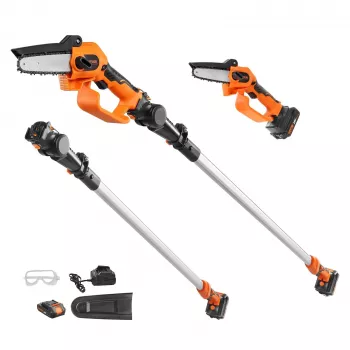
Cordless Pole Saw Chainsaw vs Battery Powered Tree Trimmer: What Works Best for Your Yard
Choosing between a cordless pole saw chainsaw and a battery powered tree trimmer comes down to reach, cutting style, and the type of branches being handled. Some tools combine both functions, letting one battery platform cover overhead pruning and close-up limbing without hauling gas equipment or extension cords.
What Each Tool Is Designed to Do
A cordless pole saw chainsaw is essentially a compact chainsaw head mounted on an extended pole, built to cut elevated limbs while you stay on the ground. That reach is the main advantage: fewer ladder moves, less balancing on uneven soil, and easier access along fence lines and roof edges.
A battery powered tree trimmer is usually a handheld pruning tool—often a mini chainsaw or powered pruner—meant for controlled cuts at chest height and below. It’s the tool for “close-quarters” work where you want steady alignment and a clean finish.
There’s overlap in naming: plenty of “tree trimmers” are simply compact chainsaws. In practice, the decision is less about the label and more about geometry—reach for overhead cuts versus control in tight crotches, interior canopy work, and ground-level limbing.
Quick Comparison: Reach, Control, and Typical Cut Size
Pole tools reduce ladder use by extending your cutting range, while handheld trimmers require you to stand closer to the branch. Handheld units generally offer finer control for directional pruning and for avoiding nearby structures like siding, gutters, and ornamental plantings.
Cutting capacity depends on bar/chain size and motor output for both types. Pole tools can feel less stable on thicker wood due to leverage—especially when the branch is angled or binds during the cut. Fatigue also differs: overhead work can burn out shoulders and upper back quickly, while extended handheld limbing can strain forearms and wrists.
| Feature | Cordless Pole Saw Chainsaw | Battery Powered Tree Trimmer (Handheld) | Best Fit |
|---|---|---|---|
| Primary job | High branch pruning from the ground | Limbing, small-tree pruning, cleanup cuts | Match to where the branches are |
| Typical working height | Above head height and canopy edges | Ground to shoulder height | Use pole for overhead; handheld for close work |
| Cut precision | Moderate (more leverage, harder to “place” the cut) | Higher (easier to align and finish cleanly) | Handheld for selective pruning |
| Setup time | May require pole assembly/locking sections | Grab-and-go | Handheld for quick tasks |
| User fatigue | Shoulders/upper back from extended reach | Forearms/wrists from sustained grip | Alternate tools during longer sessions |
| Safety considerations | Falling limb path; overhead kickback risk; keep clear zone | Kickback risk; hand placement; stable stance | Wear eye/hand protection for both |
When a Pole Saw Wins
A pole saw is the right call when the alternative is climbing or repositioning a ladder repeatedly. It’s especially useful near fences, sloped yards, landscaping beds, or roofs where ladder footing is compromised.
- Pruning limbs that would otherwise require a ladder, especially along fence lines, roofs, or uneven ground
- Seasonal canopy cleanup after storms or wind events where branches are hanging above head height
- Removing small-to-medium deadwood higher in the crown where reach matters more than perfect pruning angles
- Keeping a consistent “drop zone” below the cut to avoid damage to shrubs, decks, and lawn furniture
When a Battery Powered Tree Trimmer Wins
Why a 2-in-1 Tool Can Be the Practical Choice
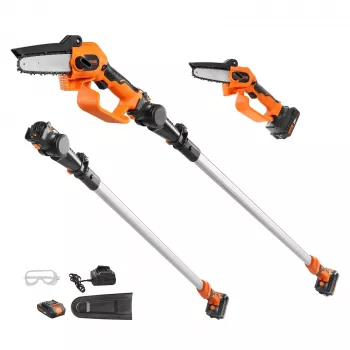
If you want one purchase to cover the widest range of routine pruning, a convertible tool like the 2-in-1 Cordless Pole Saw & Mini Chainsaw – 20V Battery Powered Tree Trimmer can streamline the job: reach up high, then switch to quick cleanup cuts once limbs are on the ground.
Battery, Runtime, and Performance Expectations
Safety and Technique Basics for Cleaner Cuts
For living limbs, use proper pruning technique: avoid flush cuts, and aim near the branch collar so the tree can seal the wound effectively. For heavier limbs, use a multi-step approach—an undercut first to prevent bark tearing, then a top cut to remove weight, then a final finish cut. For more guidance on pruning practices and timing, see resources from University of California Agriculture and Natural Resources. For jobsite-style safety reminders, consult OSHA.
Maintenance: What Keeps Cordless Saws Cutting Smoothly
Shop Helpful Add-Ons for Yard Days
- 2-in-1 Cordless Pole Saw & Mini Chainsaw – 20V Battery Powered Tree Trimmer for switching between overhead reach and close-up cleanup
- Only Women’s Classic Blue Jeans as durable everyday workwear for brush, chips, and yard projects
- Cute Cartoon Vanity Stool – Modern Minimalist Portable Shoe Changing Chair as a compact seat for breaks, tool staging, or low-to-the-ground tasks
FAQ
Can a cordless pole saw cut thick branches safely?
It can, but safe capacity depends on the bar/chain size, motor power, and the wood type. For thicker limbs, keep the cut controlled to avoid binding overhead, take small bites, and switch to a handheld tool (or a professional) when the limb is too heavy to predictably drop.
Is a mini chainsaw better than a pole saw for most yard work?
A mini chainsaw is usually better for cleanup, limbing, and precise cuts at reachable heights, while a pole saw is best for overhead branches where you want to stay off a ladder. Many homeowners get the best coverage by having access to both functions, especially during seasonal pruning.
How often should the chain be sharpened on a battery tree trimmer?
Sharpen when cutting slows, when you see fine dust instead of chips, or when the tool starts pulling to one side. Frequency depends on how often you cut and what you cut, but keeping the chain properly tensioned and lubricated helps it stay sharp longer.















Leave a comment